
Decibel / Large-format additive manufacturing
Process & materials.
A different way to make a distinctive space.
Large-format additive manufacturing (LFAM) brings 3D printing to the scale of furniture, installations, and architectural elements. At Decibel, design development, material selection, and robotic fabrication happen in conversation with your project team.
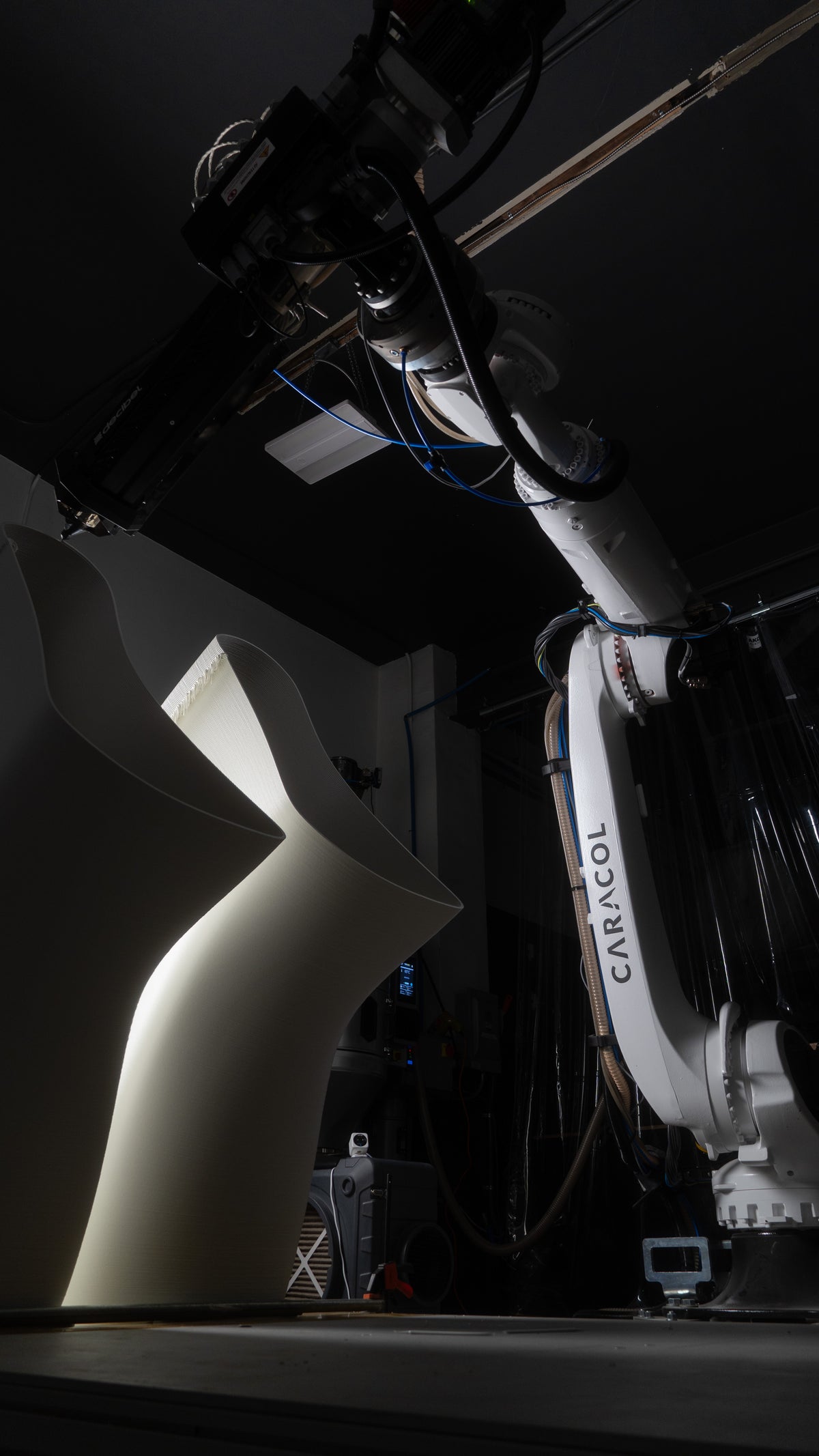
From digital geometry to physical form
The layer can be part of the design.
A robot deposits heated polymer along a programmed path, building a form layer by layer. The path, material, and geometry can shape the surface as well as the object.
For suitable designs, printing avoids a dedicated shape mold. A piece can be produced directly, or divided into components for a larger assembly. Finishing, connections, handling, and installation remain part of the fabrication brief.
Geometry with identity
Consider curves, relief, open patterns, and brand motifs as part of the object—not only something applied afterward.
One piece or a series
Explore prototypes, one-offs, and short runs with variations. Evaluate the complete scope rather than assuming a universal cost advantage.
A tangible decision
Use samples and prototypes to review scale, texture, and finish before production. Physical review complements any required performance testing.
See the process in built work.
Explore the 1,400-square-foot recycled PETG mesh installation at lululemon’s Montréal flagship, or the custom logo-patterned benches at its SoHo store.
Your team + our designers, engineers & fabricators
Resolve the making without losing the idea.
Bring a sketch, creative direction, or developed model. We will help define the next useful step.
- 01
Collaborate
Align on the concept, site, audience, and project goals.
- 02
Optimize
Develop geometry, materials, and the fabrication approach.
- 03
Prototype
Review form, scale, texture, and finish through physical samples.
- 04
Produce
Fabricate the approved design with our team in New Jersey.
- 05
Deliver
Coordinate finishing, shipping, and the agreed installation handoff.
Scope, approval milestones, prototypes, testing, and installation responsibilities are agreed for each project.
Materials & finishes
Three families. Different expressions.
Choose the character of the surface alongside how the piece will be used.
Explore three material families, each with a distinct visual and tactile character. Stone-like, wood-like, and glass-like describe their appearance and feel: these are printable polymers and composites, not solid stone, timber, or glass.

Stone-like
Glass-fiber-reinforced recycled PETG with a matte, stone-like texture. Our UV-stable formulation offers a direction for outdoor furniture and sculptural pieces, with suitability reviewed for the intended use.
Review exposure, temperature, loading, cleaning, and connection details for the proposed piece.
Core color palette
- Chalk White
- Graphite Grey
- Moss Green
- Saffron Yellow
- Terracotta Red
- Dusty Rose
- Sand
Custom colors available.
Our core palette is just a starting point. Share your brand palette or a color reference to explore a custom color for your project.

Wood-like
A plant-fiber-reinforced biopolymer with a lightweight, tactile, wood-like feel. A material direction for warm surfaces, integrated furniture, and expressive interior pieces.
Review moisture, heat, wear, and the intended environment. Outdoor suitability and end-of-life options require material-specific confirmation.
Core color palette
- Chalk White
- Graphite Grey
- Moss Green
- Saffron Yellow
- Terracotta Red
- Dusty Rose
- Sand
Custom colors available.
Our core palette is just a starting point. Share your brand palette or a color reference to explore a custom color for your project.

Glass-like
Translucent recycled PETG brings depth and light play to a layered surface. Indoor and outdoor applications are possible; appearance and suitability depend on color, wall geometry, exposure, and lighting.
Review the sample under the intended lighting, and confirm formulation, exposure, and heat conditions. This is a polymer finish, not architectural glazing.
Core color palette
- Emerald Green
- Sunset Orange
- Champagne
- Amber
- Smoke Grey
- Aegean Blue
- Amethyst
Custom colors available.
Our core palette is just a starting point. Share your brand palette or a color reference to explore a custom color for your project.
Start with a sample, not a screen color.
Physical material samples and finish swatches are available to support approvals. Tell us the material family, color direction, intended use, and project timing.
Colors shown here are indicative. Product, formulation, production method, and recycled feedstock can affect availability and appearance. Custom colors, sample requirements, and any setup costs are confirmed in the quote.
For design development & specification
The right material starts with the right questions.
Share the conditions that the finished piece needs to meet. We review the material, geometry, and assembly together.
- Application & use
- Furniture, a surface, a screen, or an installation? Share expected loading, contact, wear, and whether the piece is temporary or permanent.
- Environment & exposure
- Interior or exterior, sunlight, heat sources, moisture, and cleaning regime. Outdoor suitability is specific to the formulation and application.
- Surface & color
- Review visible layers, sheen, translucency, seams, and the finish under the intended lighting. A render does not replace a physical sample.
- Dimensions & assembly
- Overall size, panel divisions, supports, connection points, neighboring finishes, site access, and transport constraints.
- Performance & documentation
- Identify required fire, smoke, loading, acoustic, or emissions criteria early. Request applicable documentation and confirm any testing needed for the proposed material and assembly.
- Scope & schedule
- Quantities, target installation date, approval milestones, budget range, and the responsibilities of your design, fabrication, and installation partners.
This page is a design guide, not a technical data sheet or certification. No fire classification, structural rating, acoustic rating, recycled-content percentage, or building-standard compliance is implied by a finish name.
Choose the process around the project
When is LFAM the right fit?
Compared with smaller 3D-printing processes
LFAM is 3D printing at a different scale. Smaller filament, resin, and powder-based systems offer other material and detail options. Large-format extrusion suits larger geometry; fine detail and smoothness must be evaluated against the deposited bead and finishing approach.
Compared with CNC milling
CNC removes material from stock, while printing adds it. Machining can suit precise interfaces and smooth surfaces; direct printing can suit complex forms and material-efficient geometry. These processes can also be combined where appropriate. Assess the final tolerance and finish, not only the initial shape.
Compared with molding or fiberglass fabrication
Dedicated tooling can make sense for repeat geometry and larger production volumes. Direct printing avoids a dedicated shape mold, but design development, print time, finishing, and assembly still contribute to cost. A printed composite is not automatically equivalent to a specified fiberglass laminate.
Material responsibility
Made to order. Chosen with care.
Recycled and bio-based material options are a starting point—not a substitute for understanding the whole piece.
Consider useful life, maintenance, finishing, disassembly, and a realistic end-of-life route. Recycled content and recovery options depend on the formulation and application. Ask us to review those requirements at the start of the project rather than assuming every finish has the same environmental profile.
Before you brief us
A few useful answers.
Do we need production-ready files?
No. An early concept, reference image, or sketch is enough to start a conversation. Share the intended use and approximate dimensions; we can review what design development is needed.
How large can a piece be?
Share the overall dimensions rather than designing around an assumed maximum. We assess the geometry, print orientation, component divisions, handling, transport, and installation. A larger installation may be made as a coordinated set of parts.
Are all materials suitable outdoors?
Our PETG finish families include outdoor options, but suitability is specific to the piece. We confirm the formulation, color, exposure, temperature, loading, and maintenance requirements for the intended use.
Can these materials meet commercial project requirements?
Requirements need to be reviewed against the proposed material and complete assembly. Send the applicable fire, smoke, loading, emissions, or other criteria before specification. A previous project or a material sample does not establish compliance for a new application.
Can every catalog product use every finish?
No. Finish and color availability vary by product, material, and production method. Confirm the current options during quoting. Approved trade partners can request the current line sheet and discuss material samples with our team.
How should we plan the schedule?
Share the required on-site date and allow for design development, samples, approvals, production, finishing, and delivery. We confirm a project-specific schedule after reviewing scope and quantities; printing time alone is not a lead time.
Start a conversation
Bring the concept. We will help resolve the making.
Share what you want to create, where it will live, and the material direction you are considering.